

Every summer, as school lets out and Long Island families load up the car for road trips, day camps, and weekend getaways, we enter what traffic safety researchers call the “100 Deadliest Days” — the stretch between Memorial Day and Labor Day when fatal crashes involving teen drivers spike dramatically. This is not a metaphor. It is a documented, recurring crisis, and it is happening right now.
New York State Police reported a 13 percent increase in overall motor vehicle fatalities during these months from 2023 to 2024. Nationally, more than 13,000 people were killed in crashes involving a teen driver between 2019 and 2023 — and nearly a third of those deaths occurred in these same summer months, according to the National Highway Traffic Safety Administration. On average, eight people die per day in teen-involved crashes during the summer, compared to seven per day the rest of the year. These are not abstract statistics. They are our neighbors, our children, our communities.
In New York State, 30 percent of all teen driver deaths among 16 and 17-year-olds occur during June, July, and August. The risk is highest in the first year of unsupervised driving– exactly the window many newly licensed Long Island teenagers are in right now.
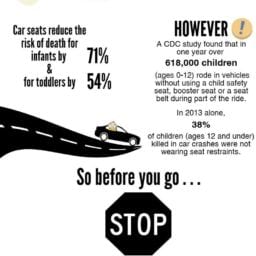
And it is not only teen drivers. For parents and caregivers of younger children, the risks on summer roads are just as real and just as preventable. According to the AAA Foundation for Traffic Safety, more than 3.9 million children under the age of 12 were involved in car crashes between 2019 and 2023, resulting in over 516,000 injuries and nearly 2,800 deaths. A properly installed car seat reduces fatality risk by 71 percent for infants and by 54 percent for children ages one to four. Yet data from the National Digital Car Seat Check Form reveals that two-thirds of all car seats inspected in 2024 were incorrectly installed or used. Two-thirds. In New York specifically, the numbers are even more troubling showing the vast majority of children were transitioned to adult seat belts far too early.
These gaps are not the result of parental indifference. They are the result of complexity, of information that hasn’t reached the people who need it most, of systems that don’t make it easy enough to get expert help. That is exactly where community organizations have a role to play.
At EAC Network, we work at the intersection of community safety and family wellbeing across Long Island and New York City. We see the downstream consequences of preventable tragedies in families, in schools, in the communities we serve. We also know that education and access to resources make a measurable difference.
Through our Teen Driving Equation program, we bring that education directly into schools and community spaces across Nassau and Suffolk Counties. The program works by engaging not just teenagers, but their parents, because research consistently shows that parental influence is one of the most powerful factors in shaping a new driver’s behavior. Last year alone, Teen Driving Equation reached nearly 5,000 people across Long Island, using curriculum built around real accountability: seat belt use, passenger distraction, speed, and the kind of honest conversations between parents and teens that rarely happen until it is too late. Presenters bring not just facts but lived experience, including personal stories of loss that statistics alone cannot convey. Schools and communities across the Island have integrated the program into their driver education curriculum because they recognize that classroom rules-of-the-road instruction, while essential, is not enough on its own.
 On the car seat side, our Safe Start program offers certified inspections and hands-on guidance for families who want to know — really know — that their children are properly protected. On September 12th, we will hold a free Safe Start car seat safety event at the Mastic Beach Public Library Satellite Branch open to any family that wants to have their seat checked by a trained technician. No appointment, no cost, no judgment. Just the expertise that most families never realize is available to them.
So what can Long Island families do right now, before the next road trip, before the next late-night drive?
Get the car seat checked by a certified technician. Not by a friend, not by assumption. A seat that looks secure is not necessarily a seat that will protect a child in a crash. The September 12th Safe Start event at Mastic Beach is a free, accessible opportunity to do exactly that.
Have the hard conversation with your teen driver. Research shows the presence of even one peer passenger significantly increases crash risk for newly licensed drivers. Talk specifically about distracted driving, about speeding, about nighttime driving — the largest share of fatal teen crashes in New York occur between 9 p.m. and midnight. These conversations are uncomfortable and necessary.
Build in time. Speeding is consistently among the top factors in fatal summer crashes. Leaving ten minutes earlier is not a minor inconvenience. For many families, it is the difference that matters most.
We ask a great deal of Long Island families. We ask them to navigate complicated car seat manuals, to monitor inexperienced teen drivers, to make good decisions in high-traffic, high-pressure summer conditions. The least we can do, as community organizations, as advocates, as neighbors, is make sure the information and support they need is available, accessible, and clear.
A version of this op-ed appeared in the Long Island Press on July 5, 2026
By Neela Mukherjee Lockel, President & CEO, EAC Network, a nonprofit organization providing community, education, and economic services to individuals and families across New York. EAC Network’s Teen Driving Equation program and Safe Start car seat safety program serve Long Island families year-round. For more information, visit eac-network.org.